When a baby starts weaning at six months, many moms look for one ingredient that is easy to add, baby-friendly, and nutrient-dense all at once. Cheese often ticks all three, yet its role is frequently reduced to a mere “flavor booster.” In one small bite, cheese delivers calcium, fat, and protein, each with a different job in a baby’s growth.
Before unpacking the benefits one by one, make sure the introduction is done right. How to choose the type and introduce it is covered in cheese recommendations for baby and how to introduce cheese to babies.
Why Is Cheese Recommended as One of the Best Weaning Food Ingredients?
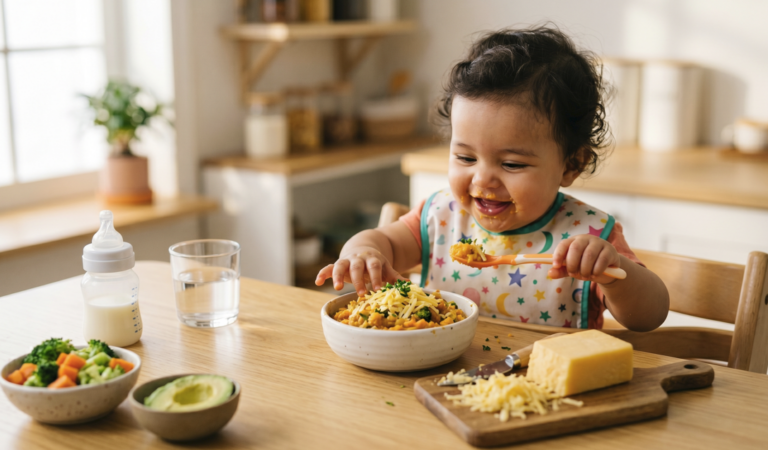
Cheese suits weaning food because it is nutrient-dense in a small volume, which matters for a baby with a tiny stomach that fills up fast. In one spoon of soft cheese, a baby can get a mix of calcium, fat, and protein without eating a large portion. Its meltable texture also makes it easy to stir into porridge, puree, or rice.
On top of that, cheese adds a natural savory taste that makes weaning food more appealing to a baby who is starting to get picky.
Cheese is not the main ingredient; it is a practical nutrient-density booster.
Choose cheese with controlled salt and mind the portion, as explained in safe and healthy cheese portions for weaning food.
How Cheese Supports Strong Bone and Teeth Development in Babies
The calcium in cheese plays a direct role in forming a rapidly growing baby’s bones and teeth. During this period, the baby’s skeleton needs a steady mineral supply, and dairy products like cheese are an easily absorbed calcium source. Cheese also contributes phosphorus, which works with calcium to strengthen bone structure.
This benefit is felt especially as a baby’s first teeth begin to emerge.
A deeper look at the role of calcium is available in the benefits of calcium for children.
The Role of Fat in Cheese for Baby’s Brain Development in the First 1,000 Days
The fat in cheese is one of the key building blocks for a baby’s brain development in the first 1,000 days. During this fastest period of growth, fat builds and wraps nerve tissue while serving as the most energy-dense source for a baby. This is why weaning food does not need to be made low-fat like an adult diet.
As long as the portion is reasonable, fat from cheese supports rather than burdens.
Use soft cheese as a complement to main fat sources like breast milk and other fresh foods. The details are discussed in cheese recommendations for baby.
How Cheese Protein Supports Muscle Mass and Physical Growth in Babies
The protein in cheese supports muscle mass and a baby’s overall physical growth. Protein is the building material for body tissue, and cheese provides it in a form that babies accept readily thanks to its soft texture. Combining protein with fat and calcium lets cheese work across several nutritional fronts at once.
For a baby who is active and starting to crawl, adequate protein intake helps a great deal.
Other high-protein menu ideas for children can be found in high-protein menu for children.
Cheese as a Natural Calorie Booster in Weaning Food for Underweight Babies
For a baby who struggles to gain weight, cheese can be a natural way to raise calorie density without adding food volume. This strategy is often advised because underweight babies tend to fill up before their calorie needs are met. Adding a little cheese to porridge or puree practically increases energy per bite.
Still pair it with medical monitoring, especially if your baby’s weight gain is a particular concern.
Other foods to support a baby’s weight are covered in foods to support a baby’s healthy weight gain.
One Ingredient, Many Benefits
Cheese provides calcium for bones, fat for the brain, and protein for muscle in a single, easy-to-add ingredient. That is why it deserves a place on the weaning-food list, as long as the portion is reasonable and the type is chosen well.
Its biggest benefit shows when cheese is positioned as a complement, not a replacement for breast milk and fresh foods.
Try starting with one spoon of soft cheese mashed into your baby’s favorite dish, then watch how they respond.